Cecil Donald Kiser & Laura Ann Rider, 1934-1956 (The Family Years in Uniontown)
Table of Contents:
• About this Folder
• Family Timeline
• Recollections of Cecil and Laura
• Cecil’s work (truck driving; Main Radio & TV)
• House on Hayne Road; life in Uniontown
• Trips between Bentree and Uniontown
• Adult children working, still at home; others moved out
• Miscellaneous stories
• Cecil’s illness and death
About this Folder:
This time period (1934-1956, from birth of the last child, Norma, through the death of Cecil) encompasses the bulk of Cecil’s and Laura’s married life and includes several major events (see the timeline below).
Shortly after graduating (or leaving) high school, all of the children had married and left home. Betty married Wendell Watson in 1944 and moved to Pennsylvania. Kate married Denvil in 1945, while he was still in the army. Nancy, Don, and Norma had also married before Cecil’s death. A summary of the various marriages can be found in the timeline below (printed 2/19/2026). Details about the family life of each of the five offspring can be found under the Kiser History tab.
Recollections of Cecil & Laura
These recollections of Cecil and Laura are primarily by Kate, Nancy, and Don. You can hear and/or read what each of them had to say about their parents by clicking on the various blocks below.
Cecil was strict, generous, fair; disciplinarian with kids; hard working. Choleric personality?
Laura was kind; more relaxed, but a person of action when pushed. Phlegmatic personality?
-
Mike: I don’t remember too much about Grandpa. I remember he had a stump thumb or finger [As detailed elsewhere, it was Wendell that I was thinking about, not Cecil]. It was cut off or something and he would pinch.
Kate: Pinch you. Then he would pinch like this…he did that to all of us. That hurt.
Mike: The other thing I remember was that he talked a lot about moving down to WV and retiring down there.
Kate: Oh yeah! He liked WV. He’d come down every fall and they would all go hunting. Do you remember that? It was Roy Marsh and Dan Moore and Daddy and Denvil and whoever else it was. I know that Shep and Dan Moore was real buddies. He came back talking about seeing this big rattlesnake; he said honestly that was the biggest thing he ever saw--that it would fit inside one of these old, galvanized washer tubs. He said that snake would have filled that thing up. But he'd come down and we’d make biscuits, me or Mom. He liked Karo syrup. So, we always had biscuits, eggs, and bacon or whatever. And he would get that Karo syrup out and eat it on one of his biscuits. He just loved to come down there. Well, Mom always liked to come down. That was home.
Kate: Nancy liked to come down, but I don’t know about Norma and Don.
-
Mike: What do you remember about Grandpa, Cecil?
Nancy: Well, he wasn’t home much! [Laugh] He was on the road a lot. He drove that van. That radio truck. He wasn’t home—maybe on the weekends. I don’t remember a lot about him. He wasn’t home that much. That was his job. He was good, he was real good at it.
Kate: He had a good job.
Nancy: Then he got a better job and went into that business; he was very generous.
Kate: Very fair.
Nancy: Yeah! That is about it.
Kate: Strict.
Nancy: Yes, he was very strict. I listened to him! [Kate and Nancy laugh] I did. Now when he looked at you, that is all he had to do.
Mike: Now I have always wondered. He had either a stub finger or stub thumb. Was it cut or something?
Nancy: Daddy?
Kate: No, not really. All I remember was the pinch.
Mike: Okay, so I was thinking it was because it was part of a finger cut off. I always wondered how it was done.
Nancy: I don’t remember that. He had big hands.
Kate: Yeah!
Nancy: No, I don’t remember that. I think that was someone else you are thinking of. Now Wendell, he had his finger half cut off.
Mike: Yeah, maybe I am thinking of Wendell.
Kate: Remember the time…there was that guy that came up there to the house. He got a new car, and he came up and took us for a ride.
Nancy: That big semi?
Kate: Daddy wouldn’t let us go. Do you remember?
Nancy: I know He wouldn’t let us go. And I remember what you said. Granny Kiser was there, and she laughed. It made you mad.
Kate: And she called me a little devil, didn’t she?
Nancy: And you said, “If I am a little one, then you are a big one.”
Kate: Sitting on the front porch.
Nancy: No, he wouldn’t let us go.
Kate: I don’t remember who was driving it.
Nancy: I don’t know who it was.
Cecil’s work
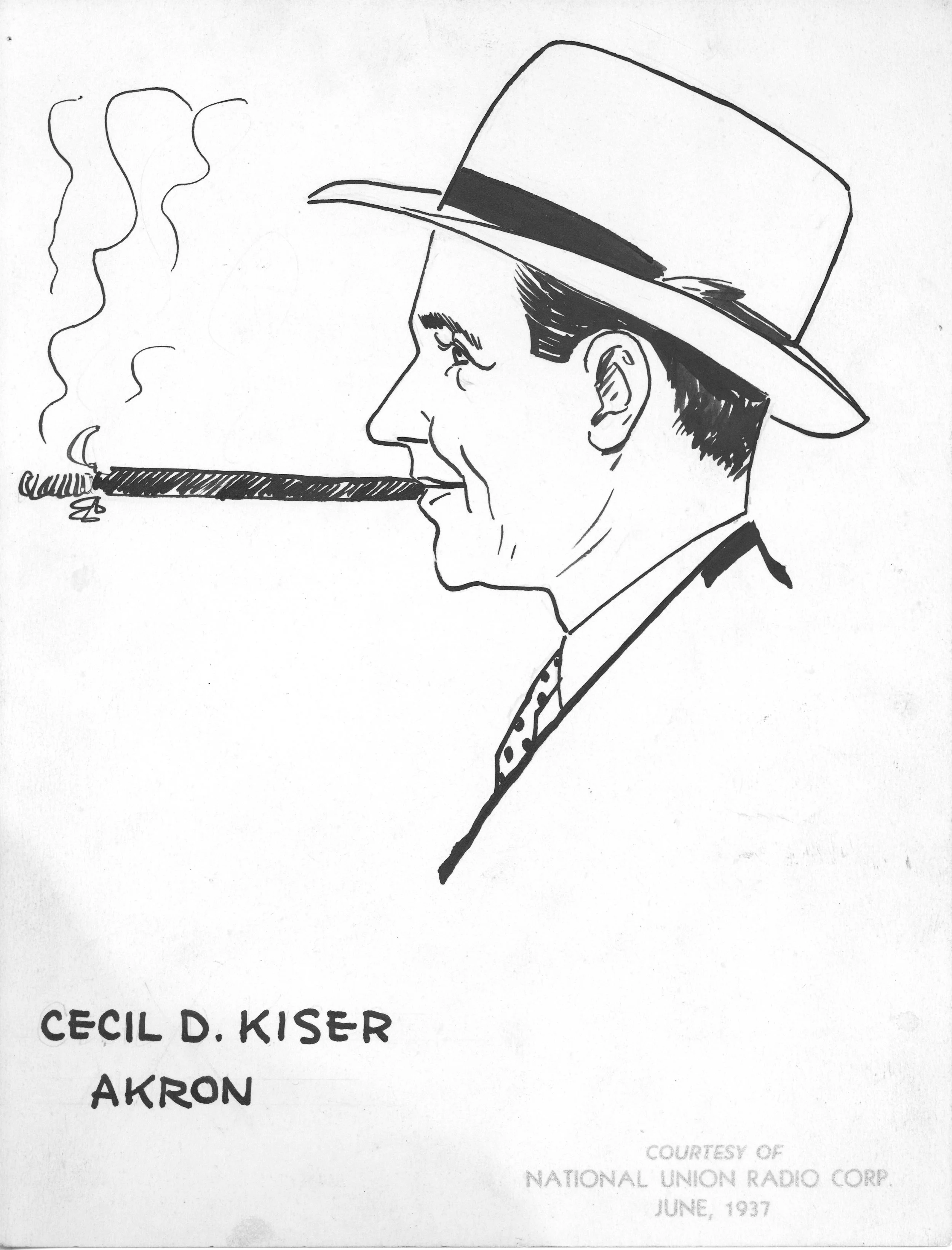
One of the first jobs that Cecil had during this period was driving large trucks. The 1930 Census lists his occupation as truck driver for Gertor (spelling?) Trucking Company. Kate mentions that he drove for Patton.
Patton Trucking, based in Akron, OH, was involved in freight transportation during the 1940’s (a time when trucking companies were expanding due to increased demand from industries and the war effort. Specific details about its operations during that decade are not readily available.
In the early days of trucking, even prior to being regulated by the Interstate Commerce Commission, common carriers numbered in the thousands and many were one truck operations connecting just one or two cities. Roads were rather primitive so many carriers were in just one or two adjoining states. There were a handful of large truckers that had been merged together from several small firms. Many of these companies you may not have ever heard of, but as they continued to buy out additional carriers for connecting routes, they became established as the great trucking companies that were left behind in deregulation.
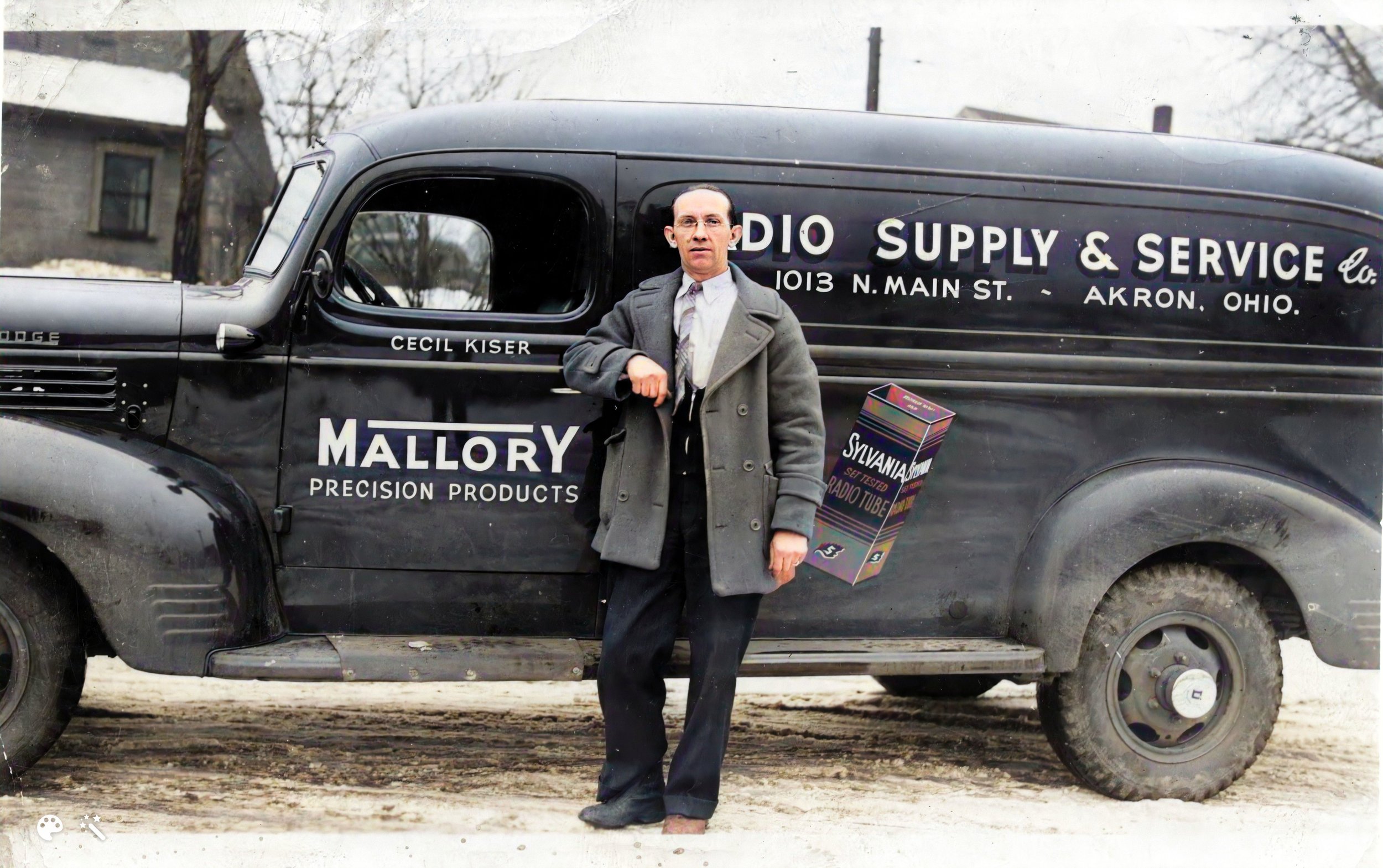
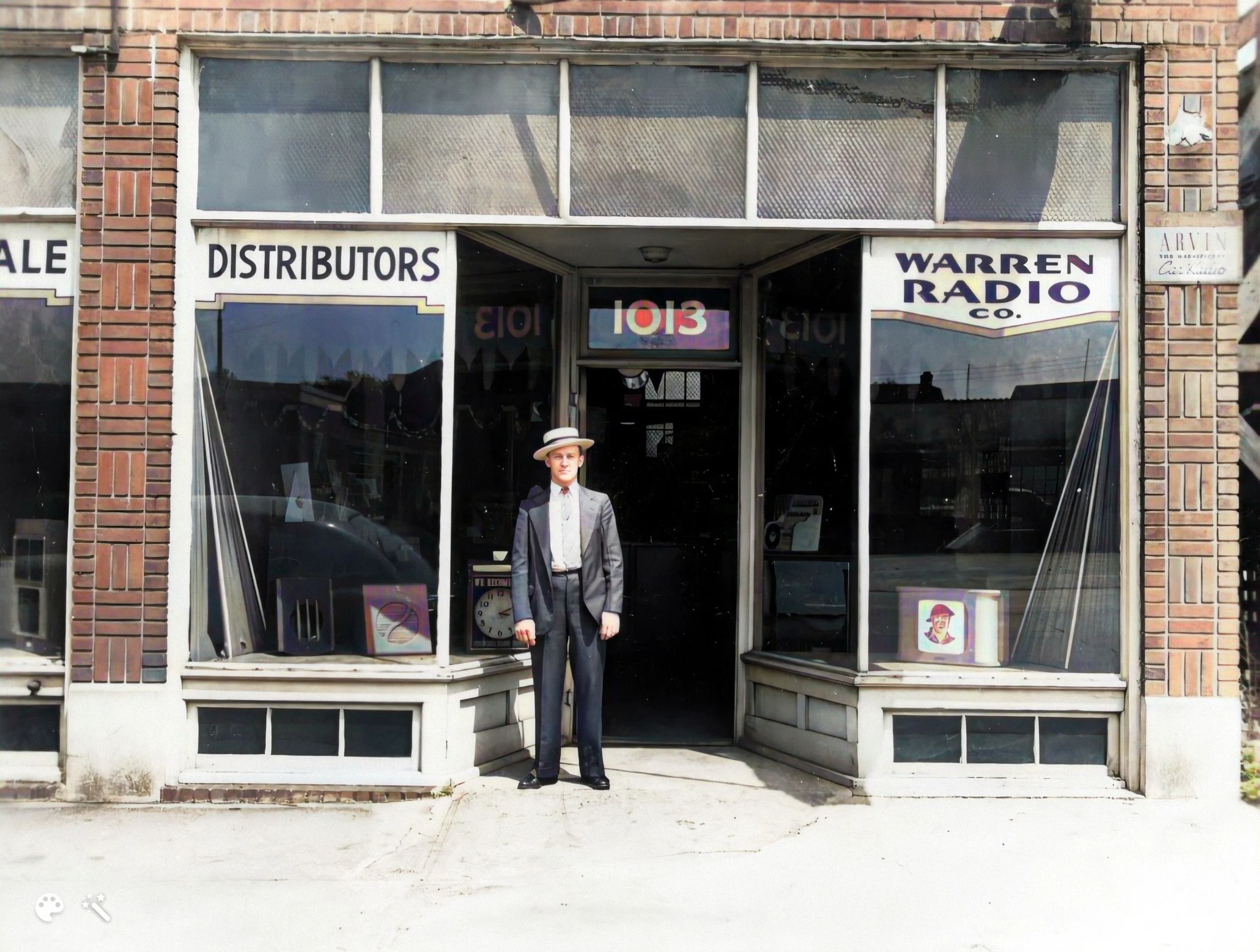
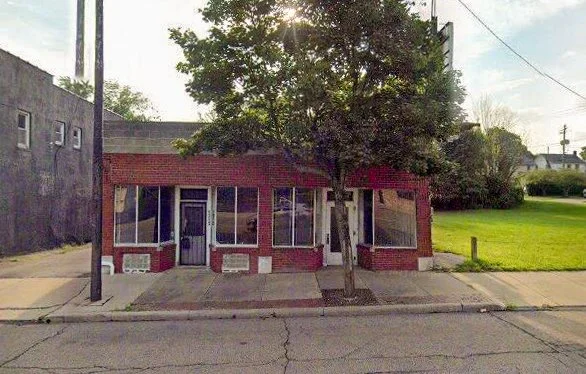
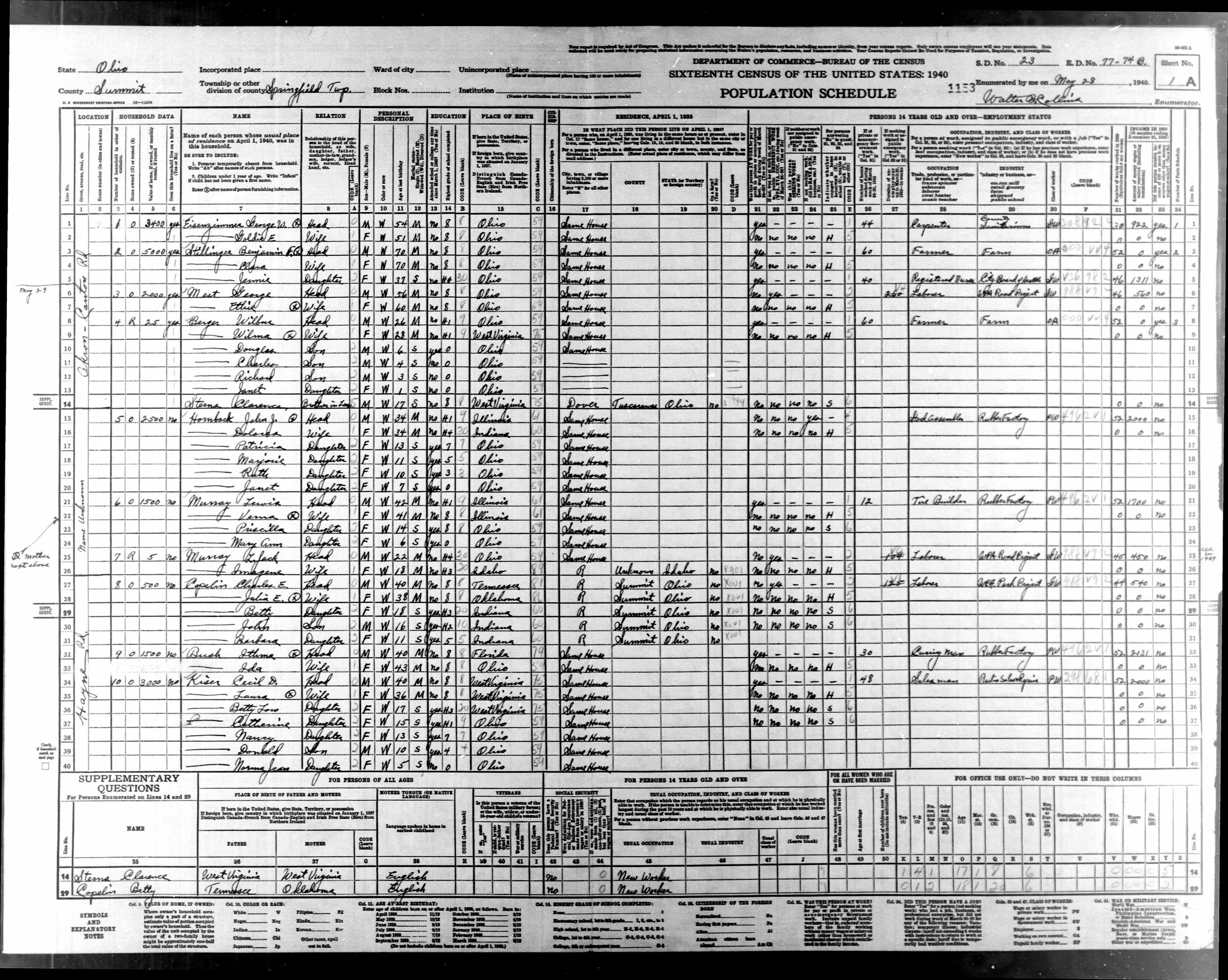
In the 1940 Census, Cecil is listed as salesman for Radio Supply & Service. Included here are two photos of the store front on 1013 Main Street, Akron. In the more recent photo the building is vacant and has no buildings on either side. I surmise that that area of Akron in the 1940’s was much more vibrant than it is today.
Cecil was a hard working entrepreneur and successful businessman. The details of his advancement are sketchy, but sometime in the 1940’s he apparently obtained ownership of the company (or perhaps a partnership). His company was one of the first to market TV’s. [I remember watching the Mickey Mouse show on an “impressive” B&W console TV, in their house on Hayne Road. That would have been around 1955.]
Cecil divested himself of the company before his death. He left Laura in good financial condition to live comfortably in her widow years.
The audio file and transcription below provide a few more details.

-
Nancy: He wasn’t much on letting us go places when he was home.
Kate: Well, he wasn’t home. Mom let us go. Mom raised us really. Daddy worked.
Nancy: Yeah, he drove all over. I don’t know how far he went—Massillon, Canton, Dover, down in through there.
Dianne: Was he gone overnight a lot?
Kate: Some. When he drove for Patton, that was long distance. And I can remember he didn’t have any heat in the truck.
Nancy: He didn’t have any windows in that truck, Mom told me. They put some kind of stuff on the window. No windshield wipers. He would have to get out and wipe the windows. Now that was when we were real small.
The House on 3059 Hayne Road; Life in Uniontown
When Cecil and Laura first moved to the Akron area, they probably lived with Lewis and Lola. Granny soon saw the need for them to move out on their own. The story of how and why they bought the house is recounted below.
________________________
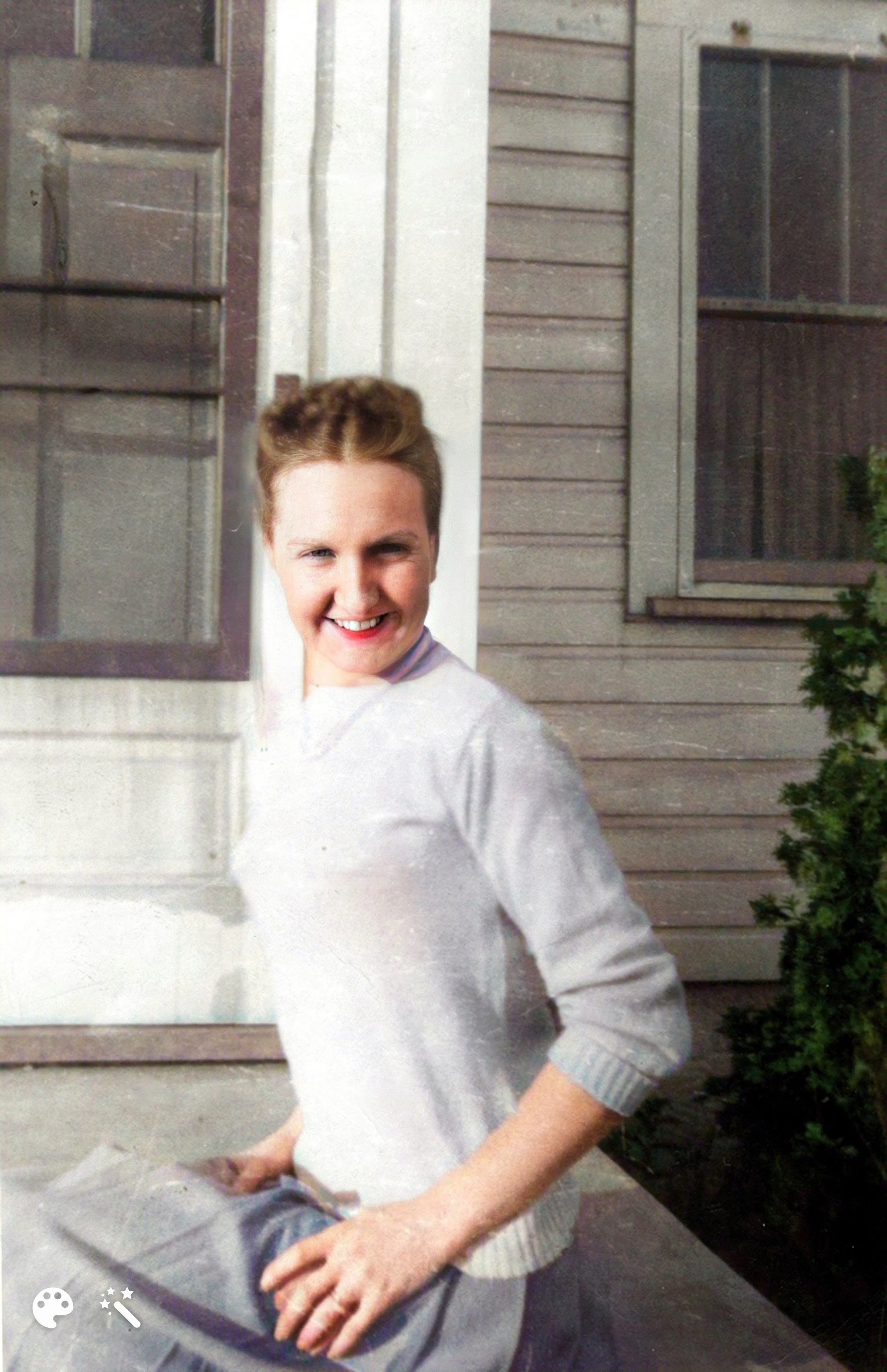
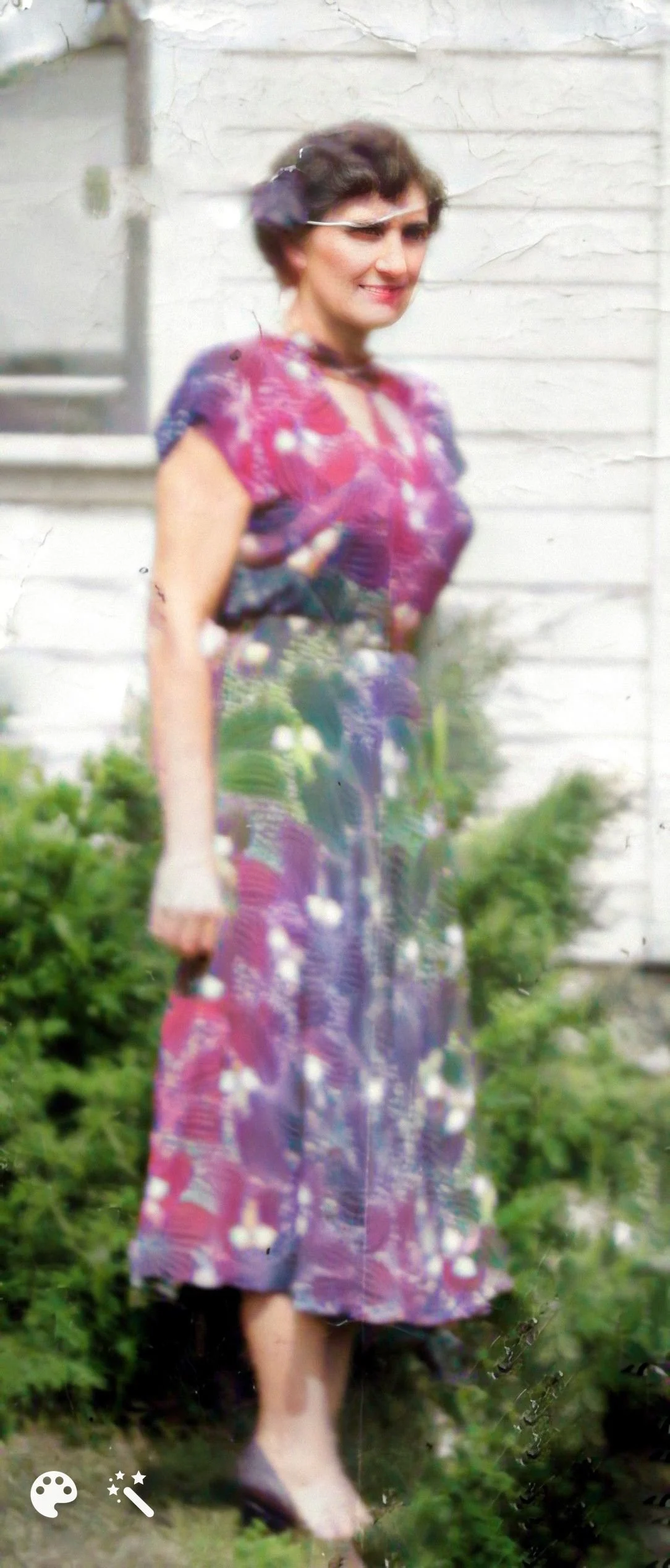
The photo below of Kate was taken in front of the house. It is the only one I have of the house itself. The other photo of Kate was taken in the front yard; the neighbor’s house is in the background. I think the neighbor’s name was Copley or Copeland. The man was a '“professional” horse shoe thrower. He had clay-lined boxes. He could toss a ringer almost every time.
The photo of Cecil and Laura was taken in the back yard. I have used it elsewhere, but I included it here to show the fruit trees. They had about an acre of land—most of the back was planted with apple and cherry trees.
-
Kate: And Mom was the one that bought the house.
Nancy: He was gone. I don’t know where he was; probably out working. When he came home, she had bought a house. The one on Hayne Road.
[Neither Kate or Nancy could remember where they lived before that.]
Nancy: I never really thought about it. Mom must have rented. Or didn’t she live with Uncle Frank and Aunt Roxy?
Kate: She may have. I don’t know.
Nancy: I think they must have lived with someone [Lewis and Lola?] when they first came up here and then she got tired of that and bought that house. I think that is the way it was. Other than that, that is about it. Kind of boring.
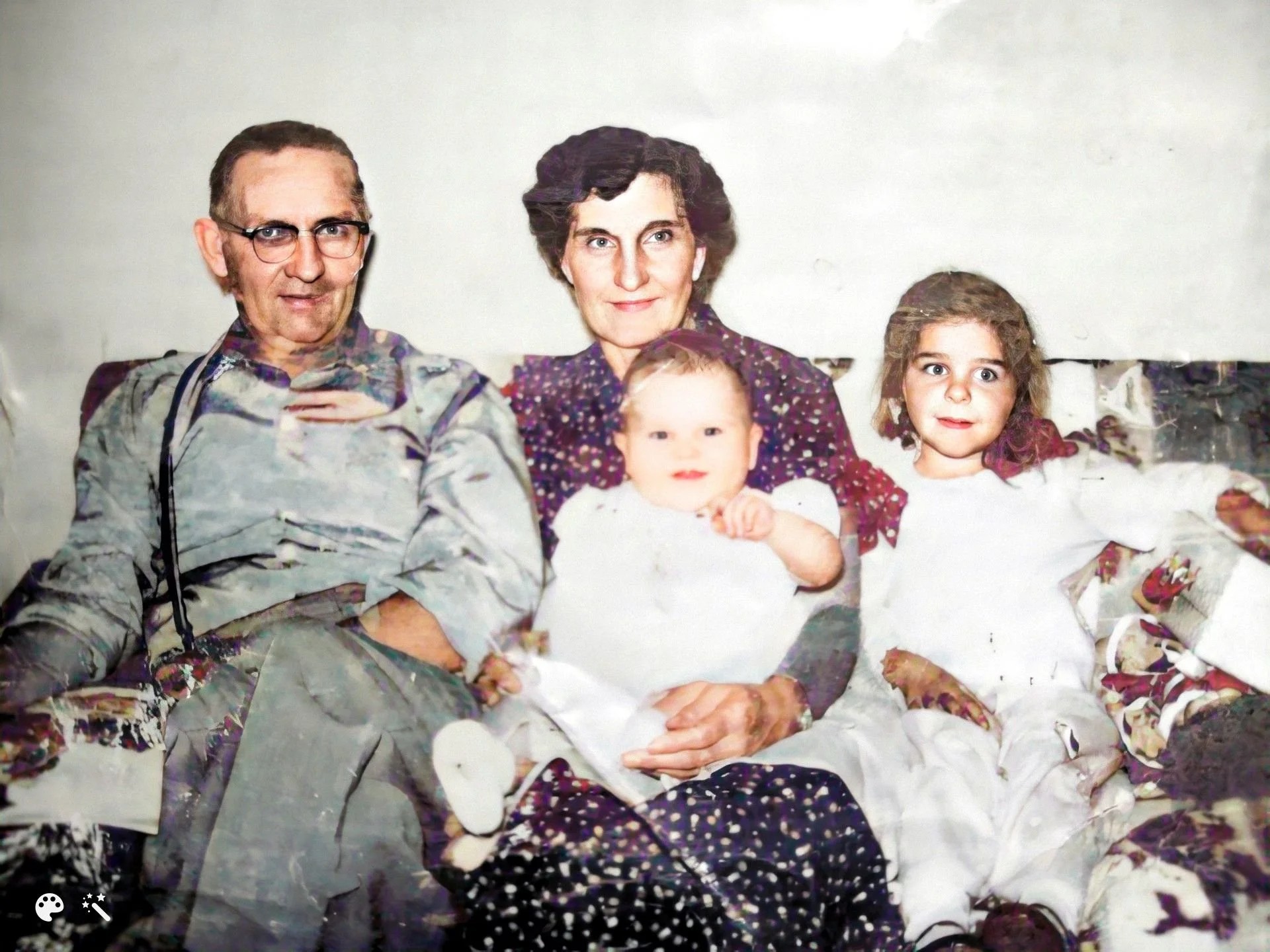
Cecil, Laura, Norma, and Nancy (abt 1935)
-
Laura: So, we got out of there and came back to Akron. That is when your grandpa got a job driving long distance trucking. I finally said to him “Dad, we are going to get us a place of our own.” He did not answer me. He thought he could not leave his mother and daddy. He was an only child, I guess I can understand it. So, one day he went out on the truck, I cannot remember if he was gone three or four days, or a week. I’d been saving money, so Aunt Roxie and Uncle Frank lived over there on Hayne Road, where Amy had been living. They said to me “well there are some places for sale; why don’t you buy one of them”. They said that would take me down and get things straightened around. I said, “Okay, let’s go”. While Dad was gone on this trip, I went and bought us a place to live. And not only that, I went and bought the furniture and everything and him not there. He went over to his mother’s when he came home, the old farmhouse. We lived upstairs and they lived downstairs. (It was over on Swinehart Farm, on County Road.) So, Dad, Cecil’s dad, said to me, “My gosh, you must have lots of money”. I said, “No, I didn’t have any money, Dad, I’ve just been saving some out of each payday. But I thought it was time we got out on our own.” They did not want us to leave, of course, he was there only child. So, after Kate was born, I said it was time to get out on our own. But Dad had never done anything on his own. We lived with his people; when he would give his payday to his mother. I never seen it. I felt like a child.
Mike: Did they move to back Akron at the same time you did?
Laura: They were already out here. They came back when we came from Whitesville. They always stayed where Cecil was at because they loved him to death, you know. And he was all they had. I guess I dare not say what Cecil said when he came home and found out I’d bought this place. Anyway, when he came home and he came over and he looked all around and he said, “How in the world did you do this, Laura”. And I said, “Well, honey, I’ve been saving money for a long time, you know that.” He gave me the money. He couldn’t manage it. He said, “I cannot manage it, you take care of it.” He said, “So, I’ll have to say it looks pretty nice.” And I said, “Well, I hope you aren’t mad at me. I don’t think your folks liked it too well. But I thought it was time, sweetheart.” So, we lived there two or three weeks, I don’t remember anymore, and he came home one evening and he said, “Let me tell you something, honey, I never knew that I could be so happy.” I said, “What do you mean?” He says, “Well, I have always been with my folks, but now this is really like living.” So, I felt pretty good then.
Mike: Tell us how you bought the house.
Laura: Well, like I said, I was a saving money. As well as I remember, it might have been $200 down. I don’t just remember the payments, but I think they were probably about $20 a month. And then when the interest came due, I paid that. That did not go into my house payment. And then when I had some extra, I would always put that in on the house payment. As I remember it was $1,200. That was a lot of money back then, honey. There wasn’t too much money. But I thought as soon as we got it paid off. Well, they had three rooms, a living room and our kitchen and dinette together. One bedroom. My couch made a full-sized bed. After we got it paid off, we added on to it. Your grandpa was pretty handy.
Mike: Where was this house in relation to the home place?
Laura: The old home place I sold? That’s where we started from, we had three rooms. We had an acre of ground. You cannot buy an acre of ground out there today for less than $10,000. Carried the water the first year, from our neighbors. We did not have a well. Then the following year, we drilled a well by hand, him and my brother, Roy. Every year we seemed to get along and add a little more.
-
Laura: This is another story. We did not have a garage, and we did not have a bath in yet. This was when he was in business for himself. So, they took off and went to Chicago on a whirlwind, I never knew what it was about. But anyway, one of the fellows, Orville, one of the fellows that was in with him in the company come out to get Dad and they were going to Canton Airport to go. And he said to me “Well Laura, aren’t you going?” And I said, “No, I wasn’t asked.” And I wasn’t too happy. They went on, and I didn’t go. I stayed home. And I was determined that I would do some work while he’s gone. So, I called Mr. Miller, from over in Suffield (?) he was in the excavating business. I told him what I would like to have done. He came the next day and removed the dirt to build two more rooms and a bath and the garage.
Well, your grandpa cut his trip short in Chicago. He came back and saw what I had done. He come in and he said, I won’t use his exact words. He said, “Well, what do you think you are doing this time?” I said, “Well, I am building me two more rooms and a bath and a garage.” He said, “Well, that’s pretty nice isn’t it?” I said, “Well, I think it is.” He said, “You aren’t too happy with me; are you?“ I said, “NO, Cecil, you hurt my feelings. The other wives went, how’s come I didn’t?” He said, “Well, we aren’t going to talk about that now.” I said, “Well, until you do, I am not going to be very friendly with you.” So, there is a lot more to the story, and I’ll finish it. [Unfortunately, we never did any more recordings.]

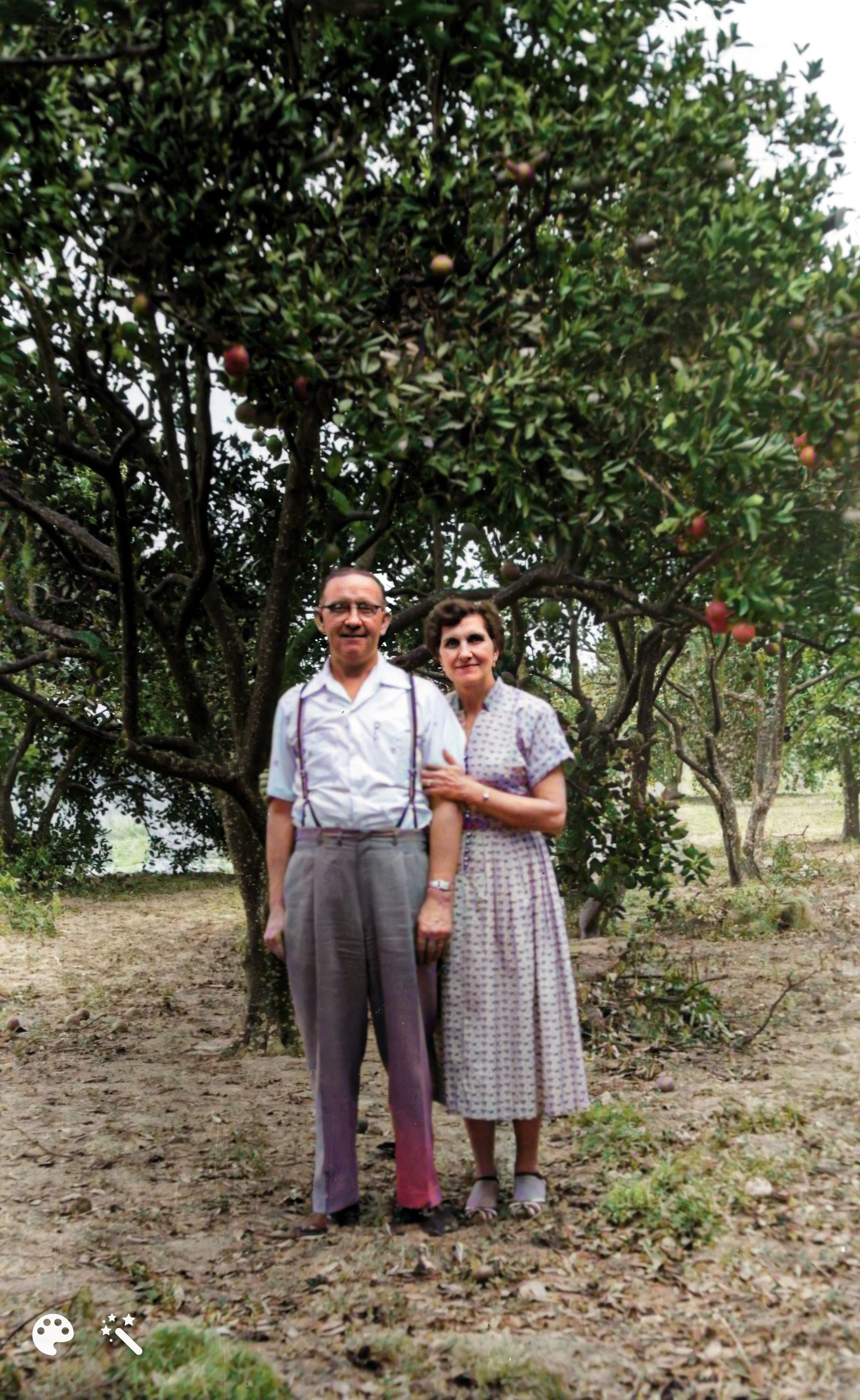
Cecil & Laura (fruit trees in backyard of house on Hayne Road)
Life in Uniontown:
Here are a couple of audio files (and transcriptions) with some eclectic information about family life in Uniontown.
-
Kate: Me and Nancy, some fella was coming out to get us. He was driving a new car…you know what I am talking about…he wanted to take us for a ride. Daddy wouldn’t let us go. So, we didn’t get to go. That must have been when Daddy was working in at Main TV. Cause he was home then. Mom wasn’t that strict on us. Daddy was. Mom was good to us. We would go ice skating every night.
-
Don: Mom completely cleaned me up in the morning. I could play all day and I would never get dirty because I didn’t like getting dirty, you know. I played with them cars. She’d clean Catherine and Nancy up, especially Nancy, and she would be dirty in 15 minutes. It was like she hadn’t been cleaned up in three or four days. Mom would go get her and smack her a few times and put clean clothes on her. She said, “Now, I want you to stay clean”. And it wouldn’t be half hour, and Nancys filthy dirty again. Ma used to get so mad.
Nancy: And I have the pictures to show it!
Don: Yeah, that one picture of you just filthy dirty. But Mom used to say, “Nancy got the dirtiest.”
Kate: She got that picture from Uncle Fred.
Kate: We always had good food.
Nancy: We always had plenty to eat. We had a big garden. Mom canned, and she made us help her. We had all kind of fruit trees, and Daddy really took good care of everything.
Mike: Do you ever go back over to that place?
Nancy: We go by there once in a while to look, because Lisa lives out in there.
Kate: She lives down close to where we used to go to school.
Nancy: They tore the old school down.
Kate: That was crazy, wasn’t it?
Nancy: Yeah, I don’t know why. But I think it had asbestos in it. And that would have been a job taking that out of there. It cost money.
Kate: What did they put in there?
Nancy: They built a school—a more modern school in back of it.
Mike: Any last words of wisdom?
Nancy: Well, that’s it.

Trips between Bentree and Uniontown:
Kate mentioned that the family would drive down to West Virginia, as least once a year. Cecil particularly liked to hunt in the fall. There are two hunting stories recounted below. I do not know where they camped or hunted, but that area was and still is pretty remote. We used to swim in Twenty Mile Creek. It has been many years since I visited that territory.
-
Kate: We went to Akron at least once a year.
Mike: I always remember that with anticipation, going to Akron.
Kate: Well, we had the same things growing up. We always went to WV. We came down at least once a year and maybe more (I don’t remember). But I know Daddy would come down every fall to hunt.
Mike: Who did he hunt with?
Kate: Roy Marsh and Dan Moore and if Denvil was off, he went. But I know those were the main two, Roy and Dan.
Mike: Now were those mostly day trips?
Kate: No, they camped out. Boy, I don’t know. I don’t remember. They would be gone at least a week. They thought that was big stuff. Camping out. I don’t know if they went toward Clay and that direction, or where. I don’t remember.
Mike: I can remember some about that, them going out hunting.
Kate: Well, I don’t remember too much. But I know they all liked to hunt, and of course they all liked to gab, too. 2:03
Kate: I can remember one time Daddy come back and they run across a rattler in the woods. And he said it could have filled a washer tub. It was so big, and it couldn’t go anywhere because it was cold. But he used to bring in squirrels and of course we always had them fried up or stewed and had gravy and biscuits. And Daddy got a wild turkey one time and Mom plucked it, and it was delicious.
Mike: What else did they hunt for?
Kate: Daddy was mainly squirrel hunting. I cannot remember that they did any deer hunting. I don’t remember that. I just remember Daddy coming down in the fall to hunt. I would get Karo syrup because he liked Karo syrup and biscuits. That is what we would have for breakfast of course with eggs and bacon. That was hunting season.
Kate: Dan Moore has been gone for a long time. He was just one of the Moore’s there. I don’t know how Daddy come to know him. Maybe through Shep [Morris] or maybe Denvil, I don’t know. Nice fella. And it kinda fell apart when Dan died. I cannot remember who else went, but I know those four going and having a good time. And Daddy had all the equipment you could need.
Mike: I remember that tent. But we set a tent up in the yard, was that the one they took. That was a big Army surplus tent.
Kate: I think it was. Of course, he had them Coleman lanterns and stoves. The stoves they had were about this long and they were green. I don’t remember…do you? I remember the stoves and of course they would cook out on them. I don’t know who did the cooking, maybe it was Dan. I don’t know whether Shep cooked or not. I don’t know whether Daddy cooked or not. I think it was Dan, but maybe they all pitched in. 05:53 I miss Shep. He was around longer than the rest of them.
Mike: Did he ever have a job?
Kate: Yeah! I don’t remember if he worked at the charcoal plant or where it was, he worked. I don’t remember. He always had money in his pockets. Maybe he played poker (I don’t know) when them fellers would get together.
-
Mike: We were talking coming down about Grandpa and hunting trips. Did you go on any of those hunting trips?
Don: I only went on one and got sicker than a dog. We went back Twenty Mile Creek. We was clear back there on Twenty Mile. And that happened to be the time Uncle Roy went. I don’t know what it was, but they had to bring me out of there. I was like 13 years old I think, maybe 14. And I got sicker than a dog. But we went 20 miles back that hollow. Uncle Roy and Roy Marsh and Dan Moore. Roy Marsh was doing the cooking. He was a good cook. The fellows they probably had some drinks up there. I don’t know if they had drinks or not. But now there were two families that lived up that hollow and they only came out twice a year to get groceries. Uncle Roy, we didn’t see him for a while. And there was a girl back there. He was back there puttin’ the make on this girl. I am 13 or 14; and I was putting 2 and 2 together what was going on there. Uncle Roy was gone three or four hours. Somebody, Roy Marsh says “Roy, where have you been?” But anyway, I didn’t believe it, but they said these people only come out twice a year to get groceries. Well, we were back there because if it rained hard…
Kate: Did they have vehicles?
Don: Yeah, we had…
Kate: No, you did. But did they?
Don: No, I think we had two vehicles that day, because I remembered the creek. If it had been raining, there were a few creeks you could not get through. The water would be too deep.
Kate: I don’t know how you went up Twenty Mile. You must have turned off there somewhere. Cause I know that Jason goes up Twenty Mile hunting and goes he goes up by Elswick’s down at Dixie. And they have a cabin up Twenty Mile somewhere. It is off the main road… way off the main road. And they go hunting up there. So, I don’t know, there must be a turn off somewhere up there. That is called Greendale Mountain now. That just takes you over into Lizemores.
[I believe Kate was confused about how to get there. Twenty Mile Creek Road can be accessed at Belva, as well as from Lizemores. Jason hunted on Cane Branch, near Gauley Bridge.]
Mike: Well, there are branches that go back into Nicholas Country. Actually, some of them go over into Clay from there.
Don: One thing I remember…I would get out there and ride on the fenders in these creeks. I thought that was fun. I was just a kid, but I was alright. Shirley could have gone went with us…I am not sure. But somebody else was riding on one of the fenders, ‘cause I was riding on the fender. I only went that one time, but that was enough for me. Boy, I got sicker than a dog.
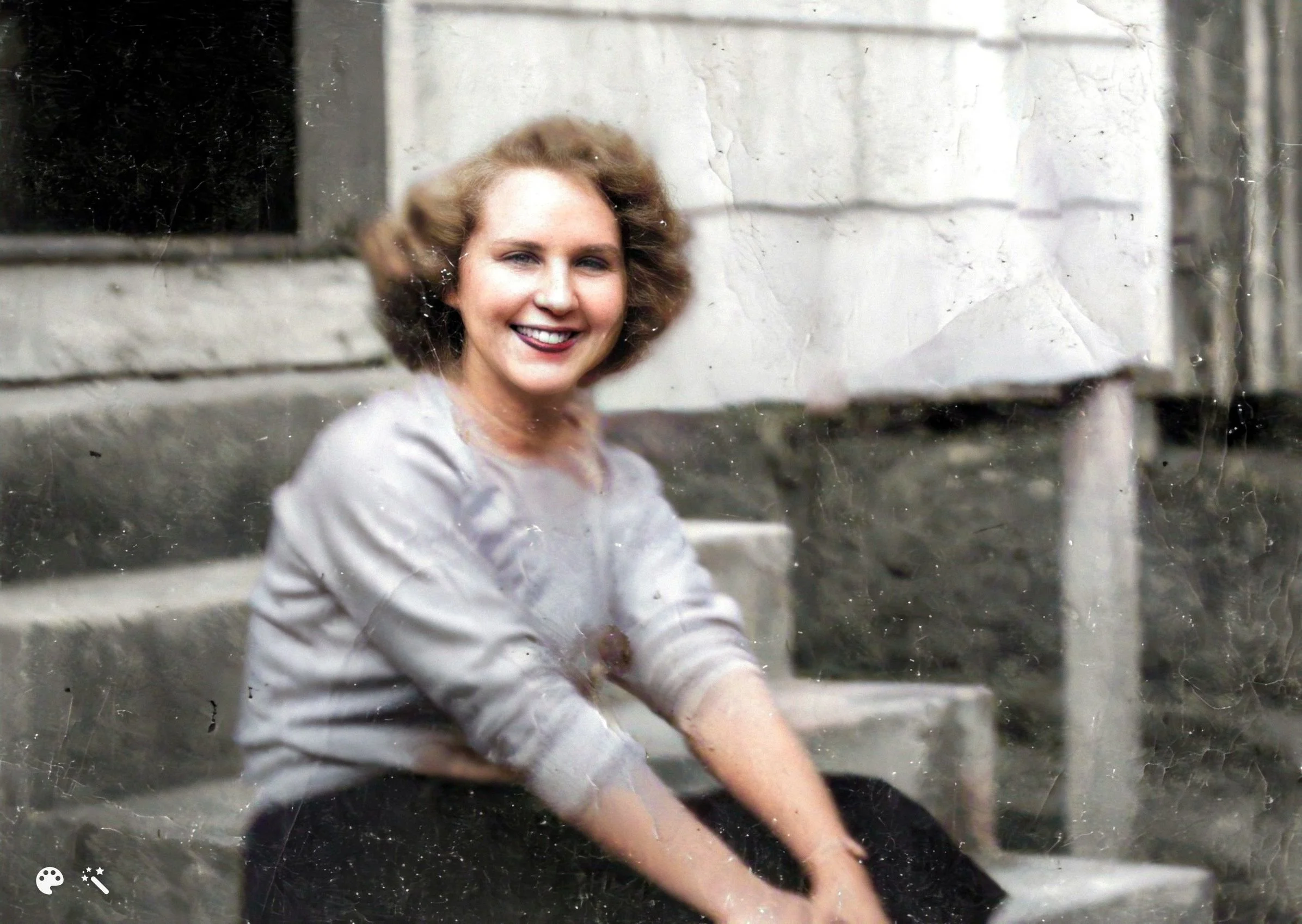
Norma, on Aunt Mary’s front steps, Bentree
Adult Children Work Experiences in the Mid-to-Late 1940’s:
There was a brief period where Betty, Kate, and Nancy were working while still living at home. You can hear them recount their experiences by clicking on the audio files below. Transcriptions are also provided.
-
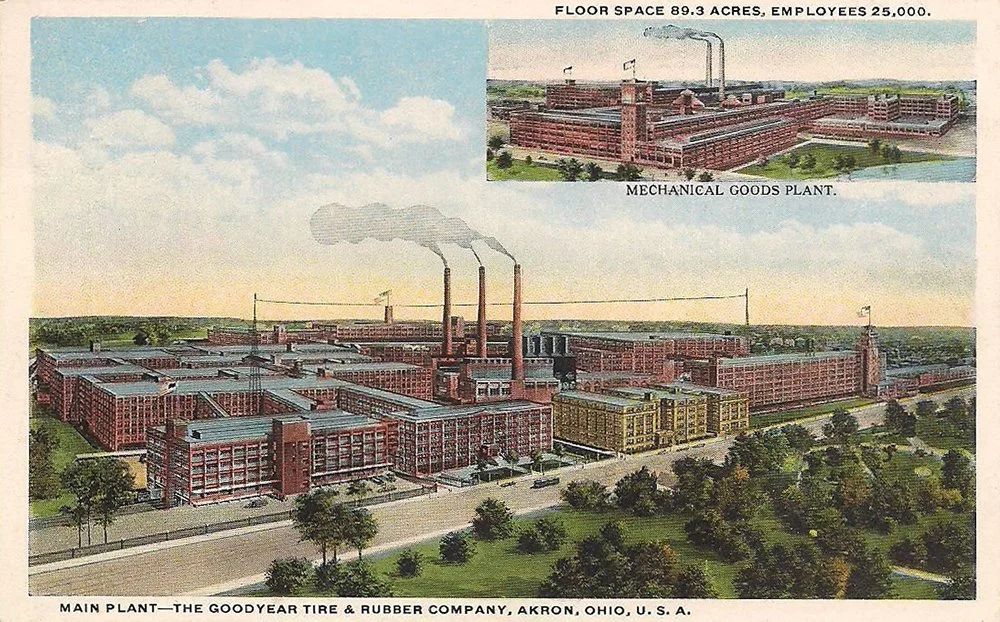
Betty: And shortly thereafter, WW II was in progress, and I was able to get a good job at the Goodyear plant making $5.35 a hour. Which to me was…
Mike: That was good wages!!
Betty: Yeah, it was wonderful. After working in a basket factory in the summer for $0.35 an hour or a five-and-ten, down in the city of Akron, for about the same amount of money. Then in the summer or 1943, Wendell was transferred from a small town in Pennsylvania called Saegertown to Baltimore, Maryland to Akron, Ohio working as a lab technician for the government. I was working on an assembly line at Goodyear making gas masks. However, the line on which I worked was attaching a canister to the gas mask to help the soldier breathe. And after about a year, I was promoted to supervisor of the line where the government girls tested these canisters, to make sure that they were usable for the soldiers. In the spring of 1944, we got wind that the war was diminishing, and that we were going to be transferred.
-
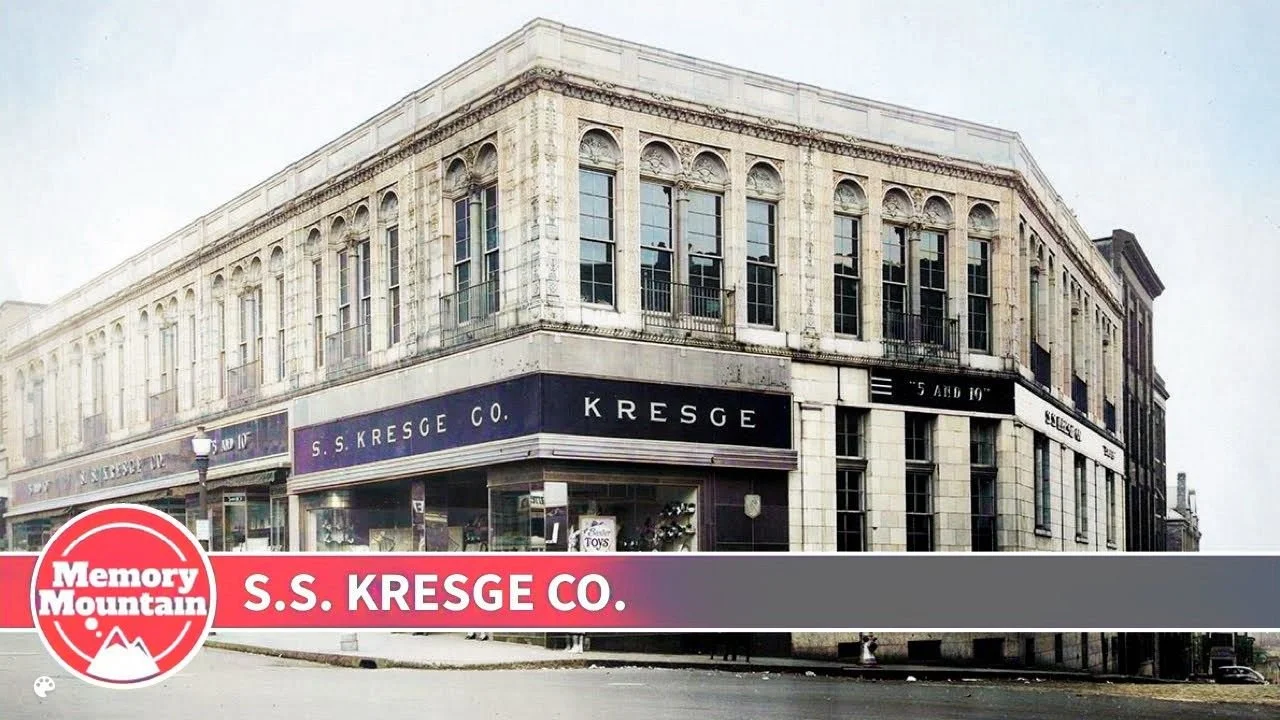
Nancy: Kresge’s was brand new, and I got a job there. I don’t remember how long it lasted.
Mike: Akron?
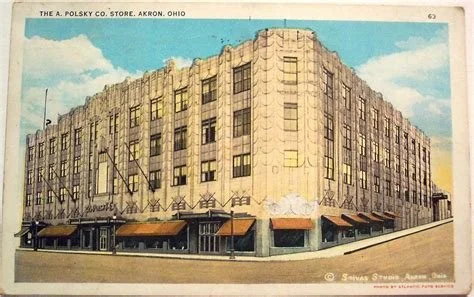
Nancy: Down by O’Neil’s. And then I got a job at Polsky’s. That is when Kate worked there, too. I worked in the candy department and the hat bar. That was fun. And then I got a job at Howard’s. Got fired from there.
Mike: Oh, really!
Nancy: Harassment. The boss…the old codger. Do you remember that, Kate? Because I would not go out with him. I wasn’t that old. I may have been 18.
Mike: How did you get down there from home?
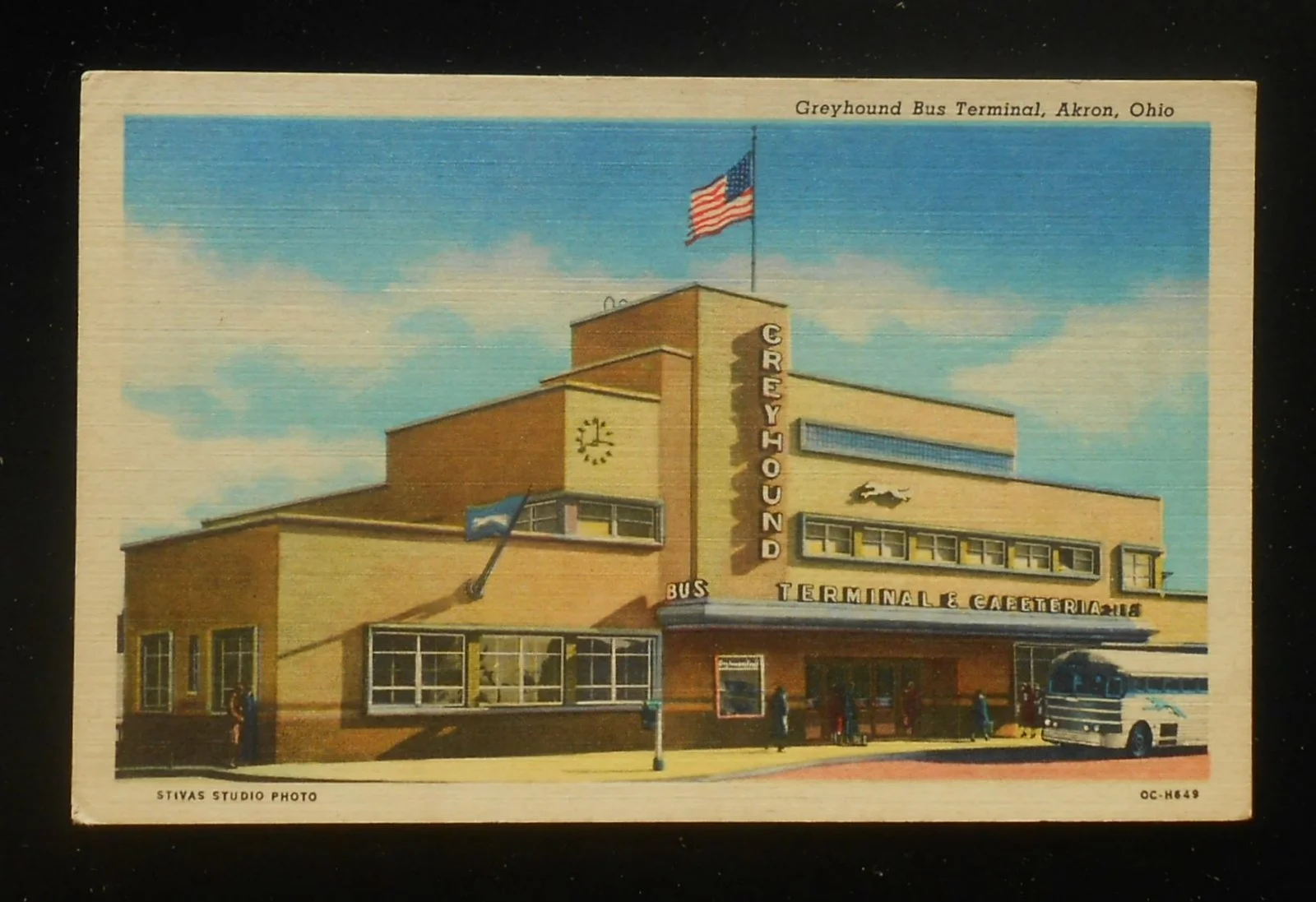
Nancy: Bus. A Greyhound….
Mike: Greyhound must not have run on Hayne Road though?
Nancy: Well, they went by on Canton Road. They went hourly, didn’t they?
Kate: Yeah! That is the only way we had to get around—was the bus.
Nancy: And the bus station was where?
Kate: Downtown, somewhere. I don’t remember, but we had to walk to where it was at.
Nancy: I guess it was Main Street. But then they moved it up on High Street. I cannot tell you much, Mike.
Kate: Well, you are worse than I am.
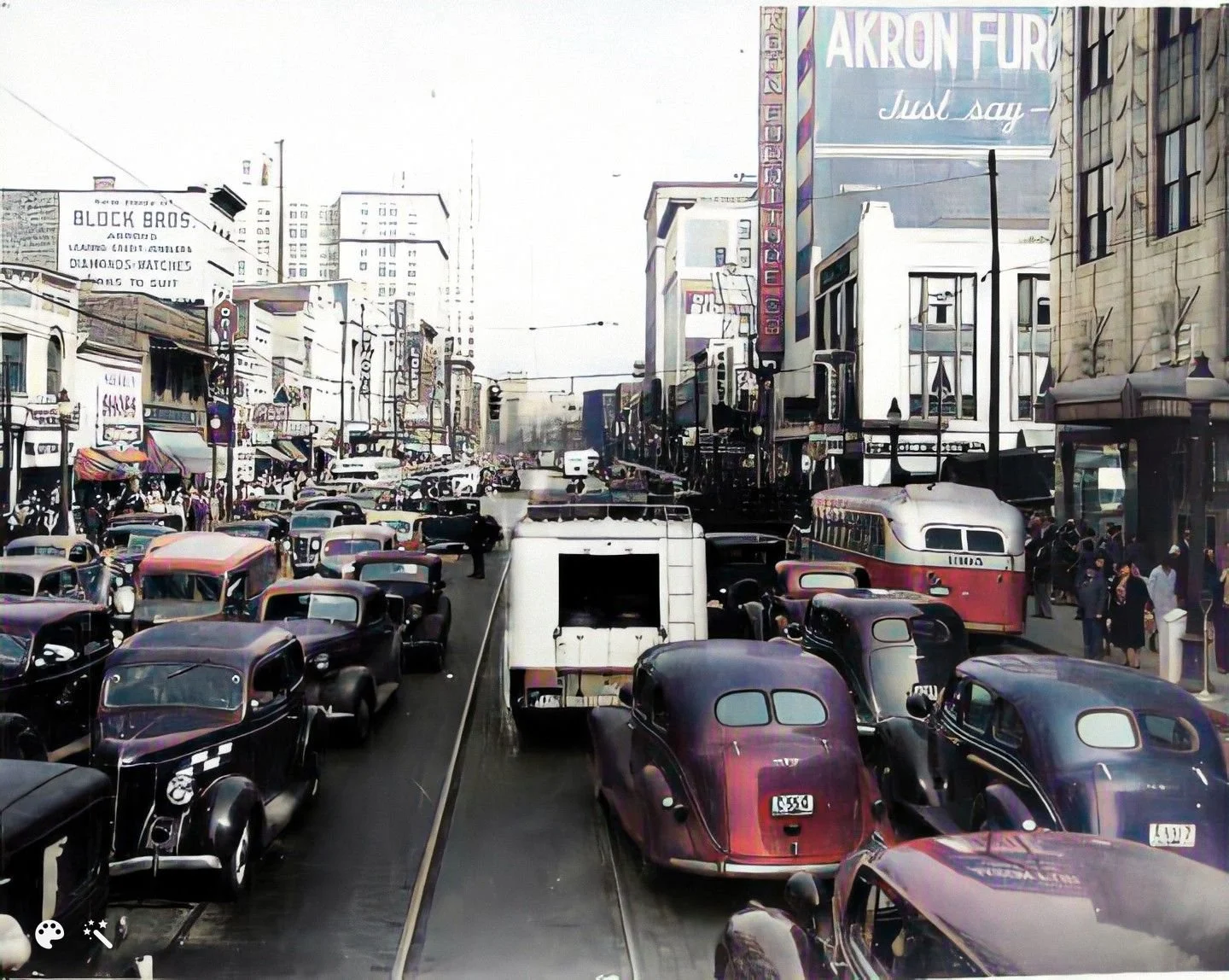
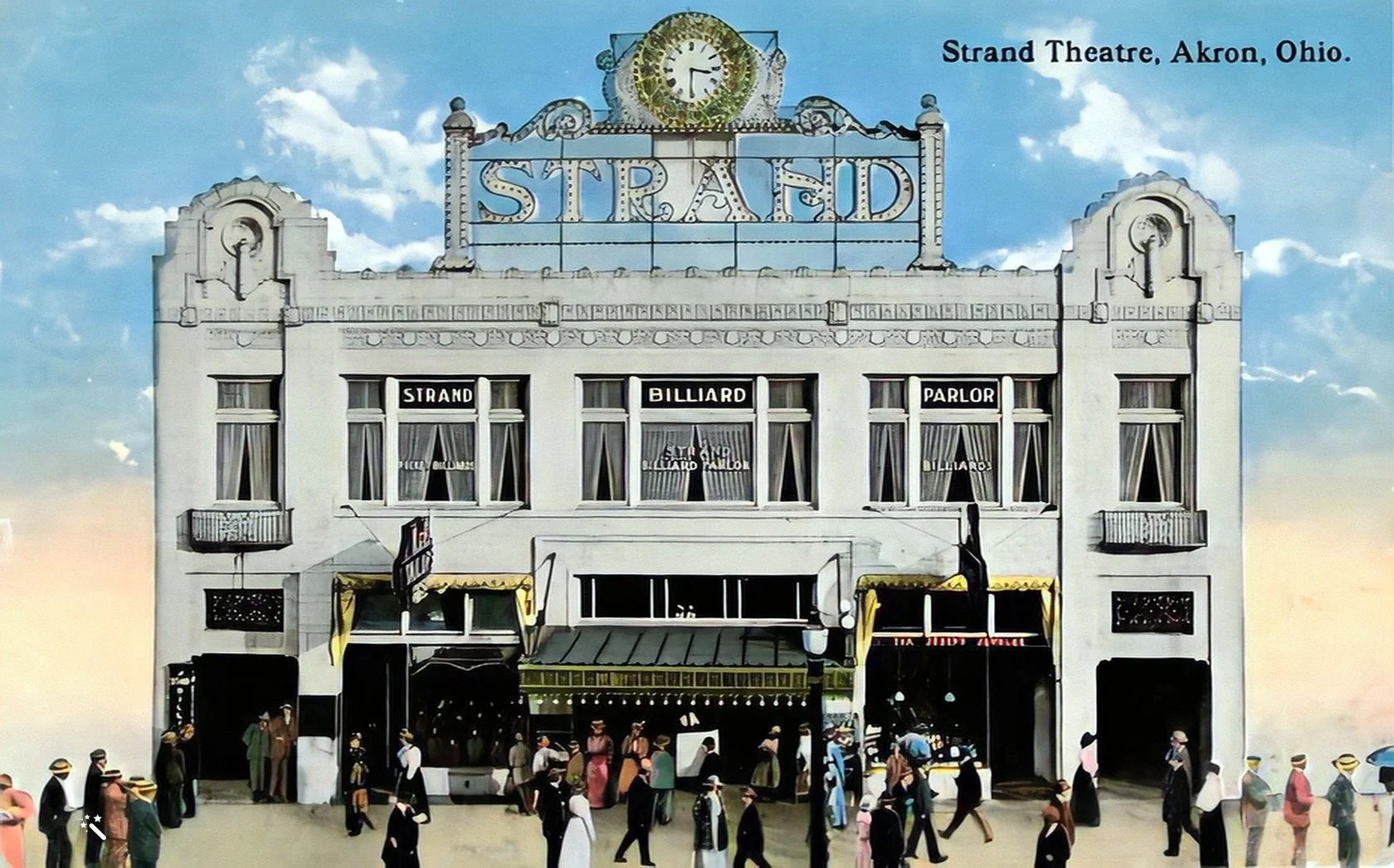
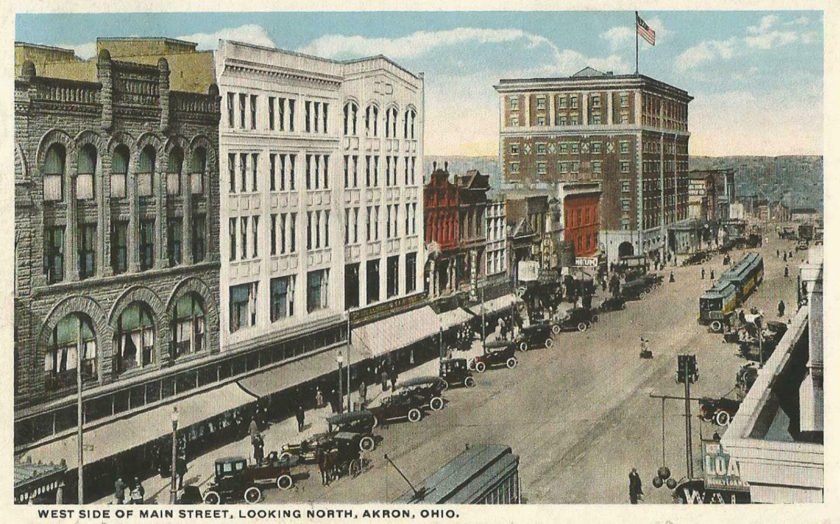
Nancy: Well, we went to the movies a lot. There were a lot of movie theatres. Powers, Lowes, Strands. Wasn’t there one named the Orphan?
Kate: Yeah, we went down the street from Polsky’s…the Main.
Nancy: That is still there, they re-did that. That is called the Civic Theatre now.
Kate: Well, that was the hang out place. Big band. At least I went.
Nancy: Well, I went some, too. But I think you went more than I did. I think Helen went a lot, too.
Nancy: Yeah, we used to run with Helen McMackin and Ann Tripp.
-
Don: Well, you know I ran into a guy, he is dead now bless his heart. Just by coincidence I was sitting up there at the Corral eating. And I got talking to this guy…I will see if you guys remember this. Do you remember the organ player down there at the Lowes Theatre?
Kate and Nancy: Both said they remembered it.
Don: The organ came up out of there. And intermission time they would bring it up...this guy was the organ player. And his last name was Proctor. I said my grandma…if I am not mistaken my Grandma Rider was a Proctor. He was from Pennsylvania. Because he said, “Don, did you ever go down to Lowes when you was young? And I said, “Yeah!” Well, he said, “I was the organ player.” I said,” You are kidding me!” At one time he said he weighted 350 pounds. But at the time I seen him, he had cancer of the esophagus. He was already down to 150 lbs. He weighed about 375 lbs., he told me.
Kate: Well, I remember that.
Don: I said, “Yeah, I can remember that thing coming out of the floor.” And he said, “Well, I was the organ player.”
Kate: You will remember they had these here…we went to see every one of them big shot bands. The big bands.
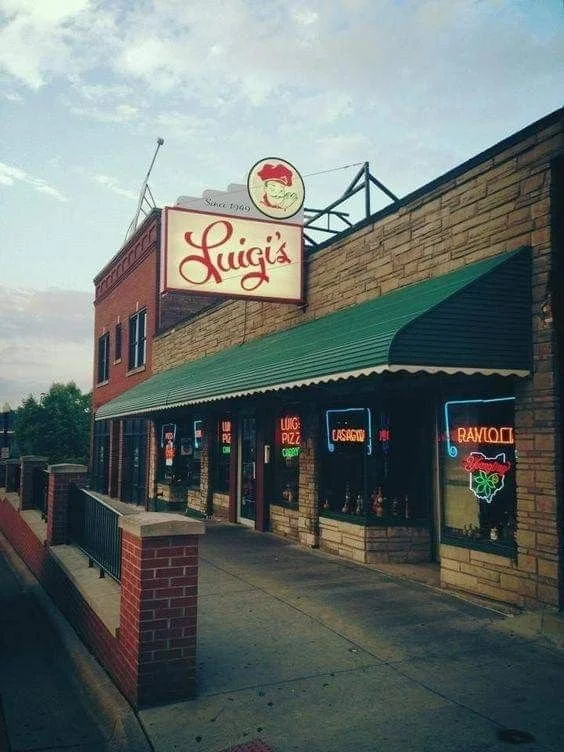
Don: I tell where you can go, Nancy, and still go down there today. That pizza place down there. What is it Luigi’s? Well down there, what used to be Main Street, but it’s that pizza place. He’s got pictures in there of all these celebrities that show up at these theatres, on the wall there.
Don: It’s Hollard Street…right next to Hollard Street. I think it’s the old South Main Street before they built the new bridge. But it’s still there. I think it went in business in 1928.
Kate: Boy, he had a lot of pictures on the wall.
Don: Oh, boy, the whole bar there was full of pictures of celebrities that had come either to Lowe’s, Palace…there was another one wasn’t there? The Strand??
Kate: There was a Strand.
Don: Yeah, I know there were two or three of them had big time celebrities.
Kate: The two main ones were Lowe’s and the Palace.
Nancy: Bill is not saying a word, he must be younger.
Kate: Now Bill, you can remember those theatres, can’t you?
Bill: Oh yeah, I’ve been there many a times. We used to ride the bus down there.
Kate: Well, that is what we rode.
Bill: Well, we rode the trolley. I walked down from where I lived at the end of the trolley line.
Kate: Well, we used to walk the tracks but now there aren’t any tracks.
Bill: Well, that is when the old doddle bug used to run through there years ago. The train went from Akron to Canton.

Miscellaneous Stories:
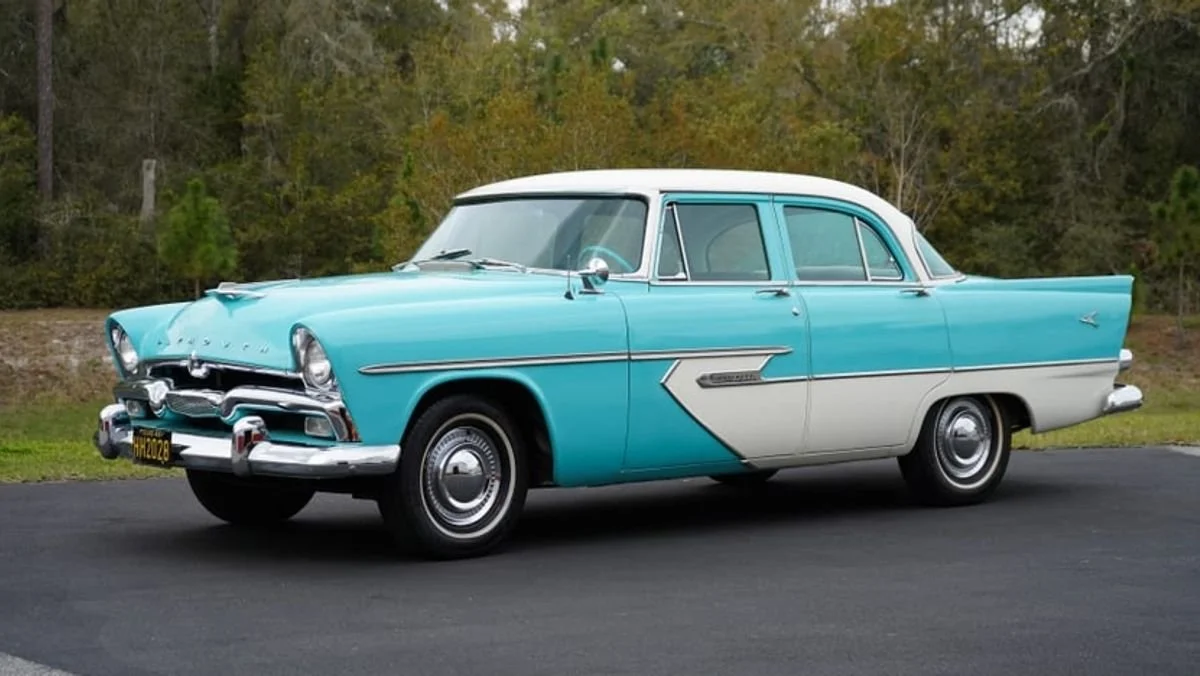
The first section talks about the brick industry in the Akron area. The second section is about a trip to Akron, told by Uncle Damon. Lastly, there a couple of photos on an unidentified beach in Florida. My guess is these were taken about 1954. (Nice convertible!)
-
Don: Mom said there was a turn-around out there by…you remember where Tripp had that feed store. Do you know anything about that Bill?
Kate: I don’t remember.
Bill: For the train?
Don: Yeah, there was a turn-around right about where Mr. Tripp built that feed house. I carried all the brick and block and mixed all that mortar in that place. Down just a little ways. Mom said there was a turn-around there.
Nancy: I don’t remember that.
Don: Cause Grandpa and Dad helped lay all them brick on that Canton Road during the Depression. They laid them great big 4 by…bricks.
Bill: That is what my chimney is made out of. The fireplace.
Don: Yeah! And they did not put them in solid. Did they put tar on them, Bill?
Bill: They put sand in them
Don: So, they were flexible, and then they were as smooth as blacktop, like brand new today.
Bill: I can remember in 1937. In Uniontown, when it was raining, and some guy came through there with a ‘37 Ford car. Tried to stop there at that light, at 619. He rolled her. And some guy from across the street there, I don’t know if it was one of them...the blacksmith.
Don: Pressler.
Bill: Pressler. Somebody went over there, and they lifted that darn thing and flipped it back on its wheels and they took off. That stuff was slicker than…
Don: Just like glass, just like ice. I can remember that because Dad was…
Bill: It was on the 224 all the way clear into Canton, with those bricks. They did it during the Depression.
Don: Cause when I had that ‘39 Ford, from Uniontown on, it had blacktop that was still the brick.
Bill: When I was a kid down there, it was just like glass. That brick in my fireplace, they are paving brick. They come off Buchtel Avenue.
Don: Did they? Well, Mom said that Grandpa and Dad helped lay them during the Depression.
Bill: They had all those people, and they paid them little to nothing. They laid that all.
Don: I think they made $5 a day or something like that, didn’t they?
Bill: They didn’t make that much.
Nancy: I thought they made $15 a week.
Bill: It was about a dollar and half or something like that. Those were all laid by hand, but they were made right down there.
Don: Mogadore Brick and Block.
Bill: Yeah, and some were made in Greene Town. I’ve got Akron Brick and Block on some of those bricks.
Nancy: I thought there was a date or a name on some of them.
Bill: It was a name, Akron Brick and Block.
A Short History of Brick Making in Stark County
The Repository, Sunday, April 15, 2001
By Charita M. Goshay, Repository staff writer
Roller bearings weren’t always the only game in town. From the late 1800s through the 1930s, Canton was the world’s leading manufacturer of paving brick. Karrie McAllister, a geologist at the College of Wooster, is researching the history of brick-making in Northeast Ohio, particularly in Canton, Wooster, Waynesburg, Malvern and Alliance. McAllister said the industry’s roots in Ohio go bact to the French and Indian War. The region’s natural abundance of high-quality clay and shale and established shipping routes made it a natural for brick-making. ‘The first brick building was build in Marietta around 1788,’ she said. Early bricks, McAllister said, were sun-dried, taking sometimes as long as a month to dry. As technology advanced, demand increased.
The first brick was used for houses. After early attempts to also used them for roads failed, a heavier, pressed ‘paving’ brick was created. McAllister said Ohio’s first paved street was built in Steubenville in 1884, and that the first mass production of paving brick in Ohio took place in Malvern in 1885 at the Canton-Malvern Fire Clay Paving Brick Co. The industry grew rapidly. By 1893, 44 Ohio companies produced 292 million bricks. Whitacre-Greer Fireproofing Co. was founded in Waynesburg in 1916, the results of a merger between Whitacre Fireproofing and the Greer-Beatty Clay Co. In 1993, the company relocated its headquarters from Waynesburg to its lone operating plant in Mahoning County, near Alliance. ‘Whitacre-Greer is the only company in Ohio still making traditional (pressed) paving bricks,’ McAllister said.
But Canton, McAllister said, was the center of the paving-brick universe. At one time, there were 15 plants operating in the city.
The Pro Football Hall of Fame sits on the site of the old Williams Brick Co., and Fawcett Stadium occupies what was the company’s shale pit, she said. Between 1885 and 1920, attorney Henry S. Belden Sr. started five brick companies, including Canton Brick, which produced the city’s first paving bricks. Belden, who also served a term as mayor, installed Canton’s first paved road, two blocks of what is now Cleveland Ave SW.
Another Belden company, Canton Cleveland Brick, was merged in 1902 with the Metropolitan Brick Co., which was run by Harry S. Renkert, a second-generation brick maker. As a result, Metropolitan became the nation’s single largest producer of paving brick. In 1923, the company produced 93 million pieces. McAllister said Metropolitan’s Ironrock Street Paver bricks were used to help build New York City’s Queens Midtown and Holland tunnels, the Indianapolis Motor Speedway, and parts of the old Lincoln Highway. It also has been on display at the Smithsonian Institution. In 1912, Harry Renkert built Canton’s first ‘skyscraper,’ an 11-story office building at the corner of Market Avenue N and Third Street NE, out of paving brick. It still is in use. The company switched to producing ceramic tile in the 1970s and became Metropolitan Ceramics. Renkert’s descendants are still involved in the company.
Belden’s Diebold Fire Brick Co. became what is known today as Belden Brick. With 500 employees, the company produced 225 million bricks a year, and still is owned and operated by the Belden Family.
Remnants of Canton’s days as a brick-making powerhouse are evident in some of its historic neighborhoods, including Ridgewood and Harter Heights, which have maintained brick streets, and downtown on Cleveland Aveune S. McAllister said Ohio’s brick industry remained viable until the 1930s. As the number of automobiles increased, demand to find faster methods of road construction resulted in more use of asphalt and blacktop, which also were cheaper. ‘It takes 500,000 bricks to pave one mile of road, 25 feet wide,’ she said.
-
Damon: I was going to tell you about that when I was visiting. Your mother was putting up wallpaper in the kitchen: just plain blue, sorta of a heavy gauge wallpaper.
Mike: Where was that?
Damon: At that house in Akron. And you put it up and tacked it. And she used little squares of white shoebox and put a tack through that. Then tacked her paper down the walls; that tack wouldn’t come through the paper. We watched her, and someone was helping her. I think your grandfather, and I can’t remember if there were any of those boys, or kids, were or not. But she was papering some in that room. I had never seen them paper that way before, see. Mom would mix up flour and make a glue, you know, and paste it on the walls. But that was a real wall papering, that she was putting up. And that is the way she put it up. And you would go in there and them big old white tabs up and down the wall. But it looked good after she got done. But then we went back to their house when Phyllis was married. See we went to McNutt’s, and we went to your grandparents. You went with us that time. I was working at the plant and bought a new 1950 model Chevrolet car. That is what we went up there in, you, and Bussy, Catherine, Freda, and me. We stayed there at your grandfather’s. McNutt’s was busy getting the wedding off, see. We stayed until it was over, and then we came back. The next time I was there was when I came back out of service; we had friends lived in Medina. We went to visit them, and, of course, Phyllis lived there in Akron at the time. Her and Joe. So, we went to their…
Mike: Barberton, I recall.
Damon: Yeah. So, we went to their house and to your people’s house and then up to the family in Medina. When we left there, we came back home. But I believe that would have been a couple of years after I got out of the army, or at least a year.
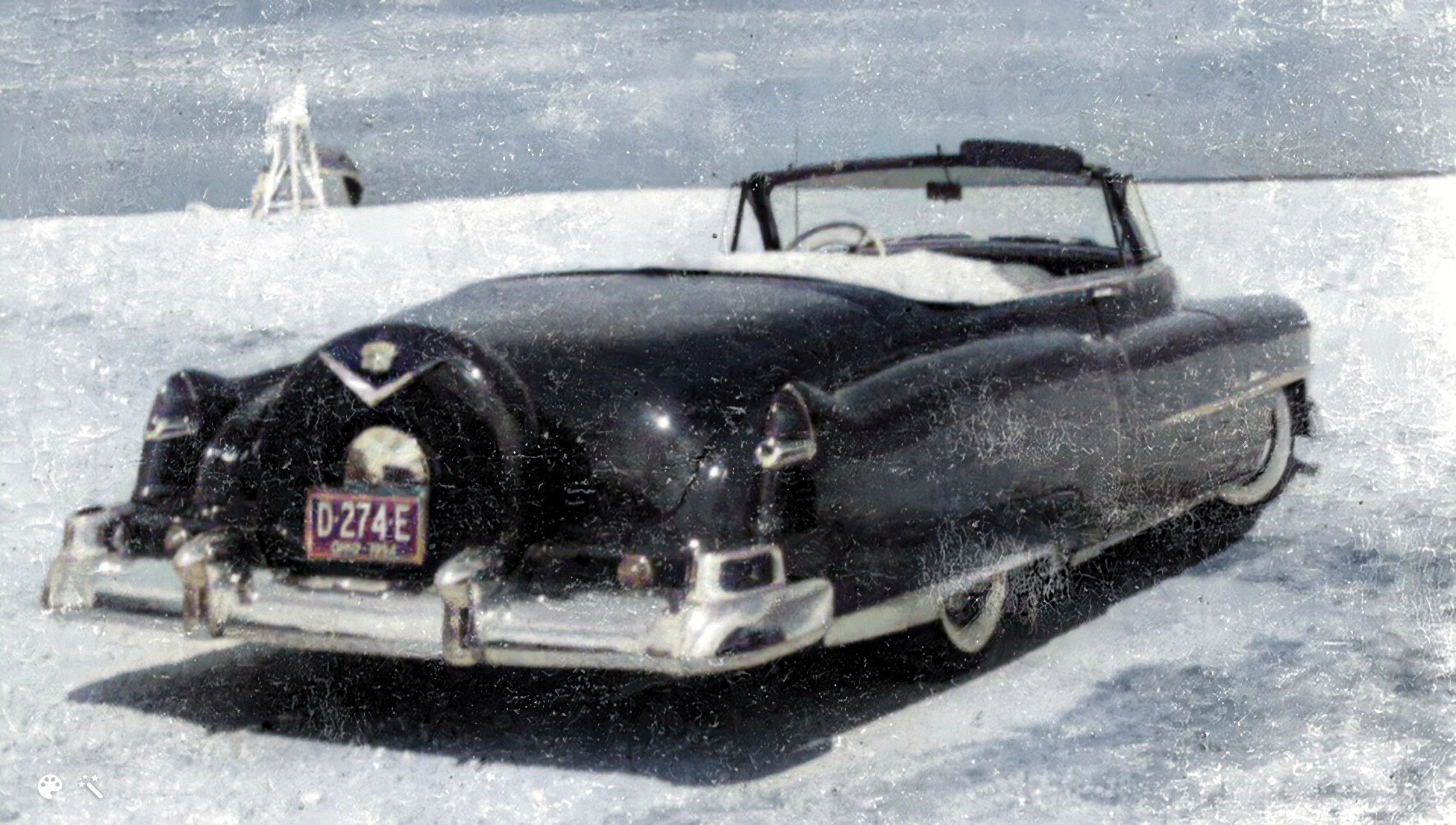

Cecil & Laura, Florida beach, abt 1954
Cecil, Illness and Death:
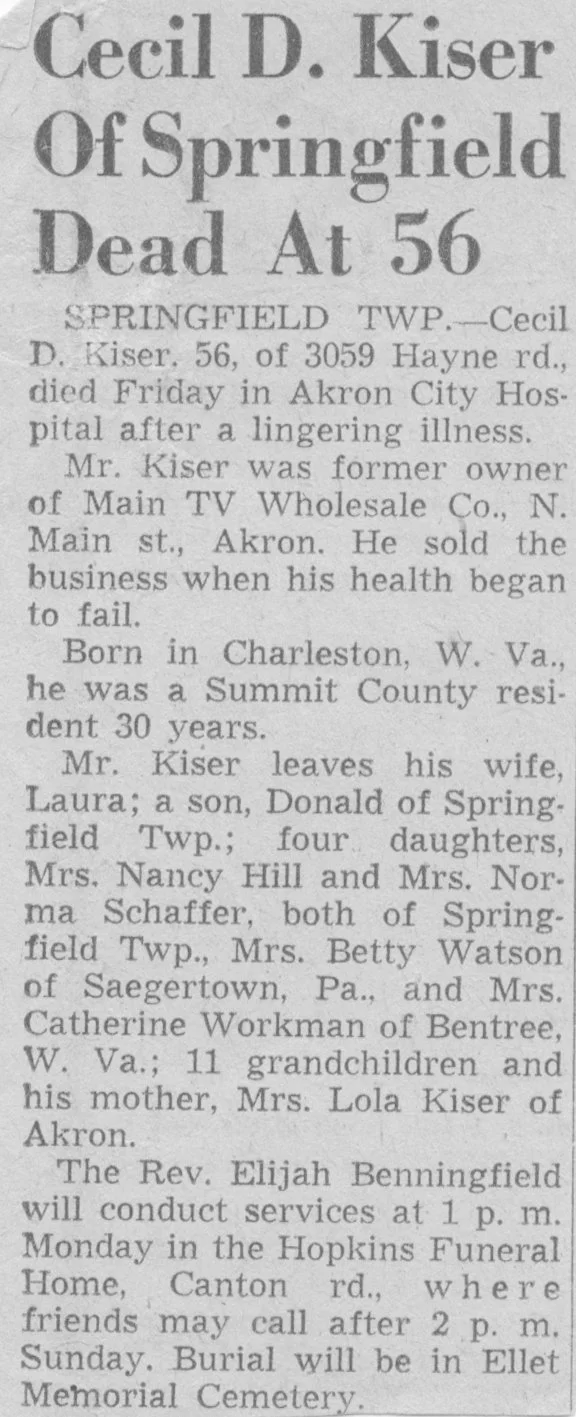
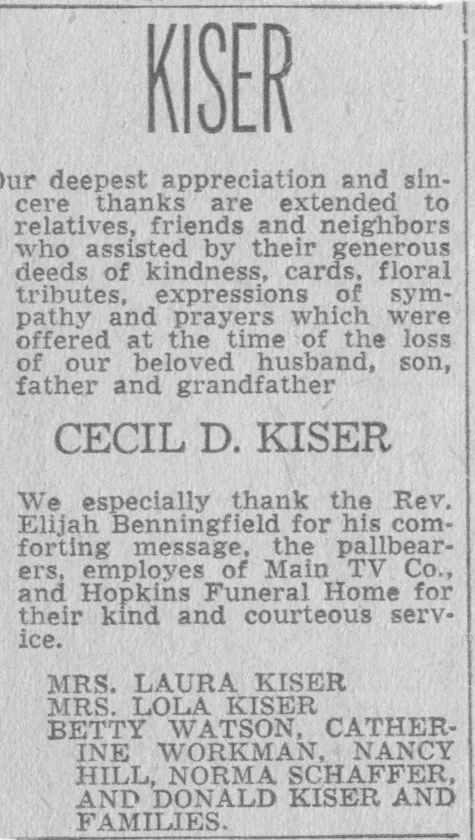
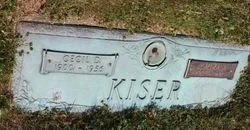
As Cecil struggled with deteriorating health, he recognized his need to reconcile with God. Through the witness of Rev. Elijah Benningfield (Pastor of Granny’s church there in Uniontown), Grandpa put his trust in Jesus for forgiveness of sins and assurance of eternal salvation.
The audio file below (by Damon) tells about my family’s trip to Akron for Cecil’s funeral.
-
Damon: I remember one detail. I bought a new Plymouth car, and Denvil was at work. I was too, of course. He come asked me if he could borrow my car, because Catherine’s dad had had a stroke. We were at the plant, and I told him that he could. I don’t remember if they got there or had just gotten there a short time, and he passed away. Then they went from there on to…was he buried in Pennsylvania? I believe. [Cecil died and was buried in Akron.]
Mike: Boy, I don’t know.
Damon: They went to Pennsylvania for something, from Akron. Denvil, Catherine and her mother. And I believe they, I was thinking that they buried him in Pennsylvania. But maybe they buried him there, and the just went over there to visit and back. But Betty lived in Pennsylvania at the time. Betty’s boy didn’t get killed at that time, did he?
Mike: No, it was a little later.
Damon: She had a son you know that the tree fell on.
Mike: Yes, that is right. That was the youngest one, and then the oldest was killed in an accident.
Damon: On construction.
Mike: On highway construction. Yeah.
Damon: But I don’t remember the details. I don’t remember why, but they went on over to Pennsylvania after your grandfather’s death. And believe it or not, when she came home…Catherine came back, Mrs. Kiser had sent me a pair of shoes for the use of the car and this and that. She sent me a new pair of shoes and I’ve got them upstairs yet.
Mike: You are kidding me.
Damon: No, I’ve got them. You’ll see them. I’ll show you what he got. Now he wasn’t no….